
Mission Control of the Future

When the Sun Wakes Up, AI is Ready
High above the lunar surface, the Earth hangs like a marble in the void, a fragile reminder of home. For the Artemis crew on the surface below, that marble is their lifeline. But 93 million miles away, a different sphere is waking up. The Sun, usually a steady companion, has developed a complex active region, a tangled knot of magnetic energy that is beginning to fray.
In the past, a mission controller might have stared at a grainy magnetogram, relying on intuition and fragmented data to make a call that could define the mission’s success, or failure. Without advanced warning tools, the decision to scrub an extravehicular activity (EVA) or retreat to a storm shelter would rely on data that arrives only after the hazard has already left the Sun. By then, the most valuable asset, time, has already been lost. Today, however, the response is different. Over the last three years, Heliolab in partnership with NASA has been building the AI machinery for heliophysics and is helping unlock a new era of human deep space exploration.
An AI Scientist for the Sun
Prior to the storm: days before the first alert even sounds, a silent revolution is already at work studying the Sun. This solar sentinel is powered by the FDL Orchestrator, an “AI Scientist” built to transform how we tackle complex interconnected problems. Historically, heliophysics research has often been manual and siloed, with specialists working on small, disconnected subsets of data using single-use workflows but heliophysics is holistic. Instead of an incremental, stove-pipe approach, Heliolab’s orchestrator is accessing a connected AI infrastructure for science, a cohesive system where AI models work in concert.
Orchestrating AI Infrastructure for Science
Using an agentic reasoning framework called “Reasoning with a Star” (based on over 20 years of NASA heliophysics syllabus), the Orchestrator breaks down complex, multi-domain problems into executable steps. It employs benchmarked design patterns to trigger multiple models simultaneously. The Orchestrator does not wait for a human to manually run a solar wind model and then feed that data into a radiation model. Instead, it orchestrates these models in parallel, synthesizing vast, heterogeneous datasets from ground stations and space missions. This enables near real-time decision-making, transforming what used to be months of analysis into minutes of actionable intelligence.
Mission Operations: Reading the Sun’s Intent

Forty-eight hours before the crisis: The silence of the Mission Operations Control Room is broken not by an alarm, but by a notification generated by this orchestrated workflow. ARCADE (Active Region Characterization and Analysis of Dynamics and Evolution), a deep learning model trained on petabytes of historical solar data, has flagged the emergence of a specific active region. It’s not just looking at sunspots, it is decoding the magnetic DNA of the region and tracking instabilities invisible to the naked eye. Without ARCADE, this magnetic evolution might go unnoticed until the eruption actually occurs, forcing mission control into a reactive posture rather than a proactive one.
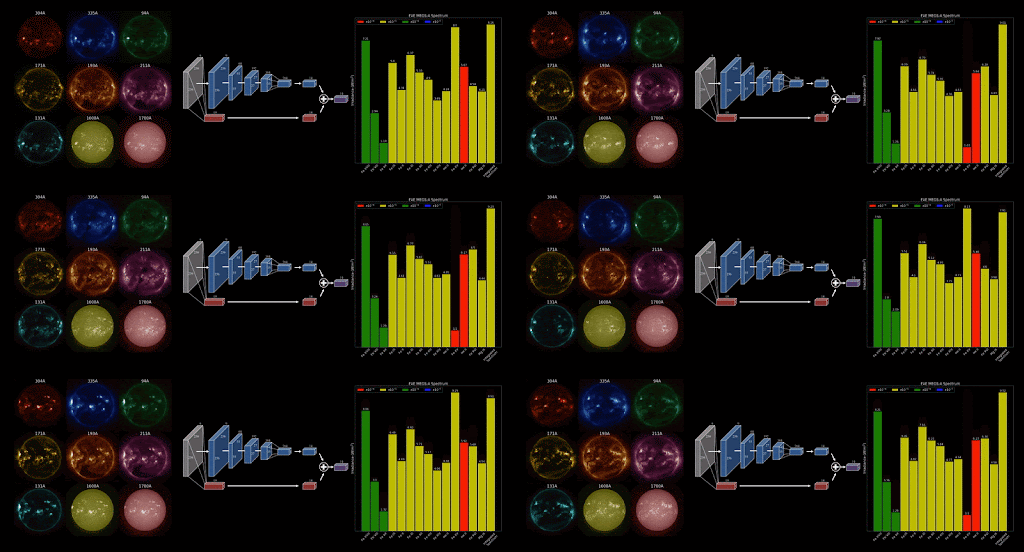
Simultaneously, the Multimodal Flare Prediction FOXES model acts as a ‘virtual’ X-ray sensor. Using Extreme Ultraviolet (EUV) imagery from the Solar Dynamics Observatory (SDO), it pinpoints the exact locations of multiple small flares across the Sun with unprecedented precision.
In a traditional workflow relying solely on the GOES satellite's integrated flux, operators would know a flare was building but not where it was located, leaving uncertainty about whether the blast was aimed at the Earth-Moon system. Now with a clear view on the current situation, the order goes out from ground control: cancel the upcoming EVA sample retrieval. The crew remains in the lander. The system has bought them the most valuable resource in space exploration: time.
The Eruption
T=0: When the Coronal Mass Ejection (CME) finally erupts, it doesn't travel through an empty vacuum. It plunges into the solar wind, a turbulent, magnetized river flowing from the Sun. Understanding this river is critical. A CME hitting a calm stream is one thing; a CME sweeping through a Stream Interaction Region (SIR) is a different beast entirely, compressing plasma and amplifying the storm's magnetic punch. Without the ability to decode these structures in the ambient wind, predictive models might underestimate the storm's severity, leading to inadequate preparation for the incoming shock.
This is where the Decoding Solar Wind Structure pipeline steps in. Leveraging data from the Parker Solar Probe, it uses advanced clustering algorithms like iSAX and HDBSCAN to characterize the ambient wind. From an automatically curated catalogue of historic data, which itself has revealed previously unseen structures, it identifies that the CME is indeed riding a disturbed wake. Crucially, the Orchestrator ensures these insights aren't siloed, a prediction pipeline feeding the solar wind analysis directly into arrival time predictions is created and ready for review. Without being overwhelmed with a deluge of information, the operation in the room is able to approve the pipeline and sees the prediction linked to the active region being tracked by ARCADE.
The Crisis: The Radiation Storm
24 Hours later: The second blow lands. The active region flares, an apparent X-class monster. Moments later, a stream of Solar Energetic Particles (SEPs) sleets toward the Moon. Initial analysis is unclear, with GOES completely saturated. Thankfully Multimodal Flare Prediction and FOXES is running, making use of SDO AIA data instead. In an instant, FOXES identifies that these are in fact two flares, a smaller M-class flare triggering a massive X-class flare. Both are localized on the solar disk and magnitudes estimated.
For the astronauts, this is the moment of highest risk. But they are not flying blind. The Forecasting Radiation Exposure model, trained on decades of data from missions like BioSentinel, has already predicted the onset. More importantly, it forecasts the decay profile of the event. It tells the crew exactly how long they must shelter. Without this decay forecast, astronauts might be confined to cramped shelters longer than necessary, wasting mission time, or worse, emerge too early into a still hazardous environment. Interestingly, the CME's magnetic field sweeps away background Galactic Cosmic Rays, a phenomenon known as a Forbush decrease. The system accounts for this nuance, calculating the precise net radiation dose. The crew is safe, huddled in their storm shelter, watching the red curve of the forecast trace their safety in real-time.
The Footprint: Resilience on Earth
The storm doesn’t stop at the Moon. Even before it slams into Earth’s magnetosphere, the Geo-CLoak system from Multiscale Geoeffectiveness and Geoeffectiveness Continual Learning is activated by Orchestrator. First the SHEATH model tracks the progress of the solar wind, giving increasingly accurate predictions as new data is added.Integrating the advanced continual learning DAGGER-CL pipeline, which continually adapts to changing input data and context, localized geomagnetic perturbations are predicted globally. Grid operators in high-latitude regions receive actionable warnings to safeguard power transformers against induced currents. Without these localized warnings, power grids may become unstable and potentially lead to widespread blackouts, severing the lifeline which is anchored by satellite ground stations on Earth.
Meanwhile, the ionosphere, the chaotic layer of atmosphere that reflects radio waves, ripples and surges. The Ionosphere-Thermosphere Twin developed with NASA JPL forecasts Total Electron Content (TEC) maps with high fidelity. This ensures that ground stations can correct GNSS signal delays, maintaining a lock on the Artemis spacecraft when it matters most. Without accurate TEC forecasting, GNSS errors could degrade navigation precision, risking critical maneuvers and telemetry links, again severing the lifeline connecting our astronauts to home.

Meanwhile, the Thermospheric Drag and Thermospheric Density Continuous Learning Karman-CL model runs in parallel, providing high-fidelity estimates of drag for Low Earth Orbit (LEO) satellites to prevent collisions in a crowded sky. Without this density forecast, satellites could lose altitude unpredictably or collide with debris, with a devastating cascade of collisions compounding. Not only does this threaten communication relays and support options, but also makes the return trip hazardous.
The Foundation: Unlocking NASA’s Fleet
Having a unified response across domains is only possible because we have fundamentally changed how we use data. We have moved beyond raw telemetry to machine learning ready datasets. The Analysis Ready Data (ARD) computational engine transformed the SDO archive into a clean, standardized SDO-ML format that forms the basis for all other Heliolab outputs using SDO imagery, while Decoding Solar Wind Structure and Multimodal Flare Prediction created unified catalogs of wind structures and flares, realizing untapped potential from multiple NASA missions.
A new way of using data
Having a unified response across domains is only possible because we have fundamentally changed how we use data. We have moved beyond raw telemetry to machine learning ready datasets. The Analysis Ready Data (ARD) computational engine transformed the SDO archive into a clean, standardized SDO-ML format that forms the basis for all other Heliolab outputs using SDO imagery, while Decoding Solar Wind Structure and Multimodal Flare Prediction created unified catalogs of wind structures and flares, realizing untapped potential from multiple NASA missions.Underpinning this potential are foundation models like SDO-FM and Surya. These massive models allow us to see cross-modality interdependencies, connecting a flicker in a solar image to a plasma reading millions of miles away, in ways human researchers never could before.
A new era of exploration needs a new era of trust
Apollo’s Flight Controller, Gerry Griffin reminds us that radiation is humanity’s greatest challenge as we return to deep space. Astronauts need to trust that when the red light flashes on the console, the science behind it is sound. Trust that we understand the heliophysical processes well enough to bet human lives on them.
By weaving together the threads of solar physics, data science, and systems engineering, we have moved away from building single-use isolated models using curated data. Instead we have built the orchestrated AI infrastructure needed to inform the decisions of operators.
As we venture further into the solar system, we go with the confidence that we are not just rolling the dice on the Sun's storms, we understand and are ready for them.
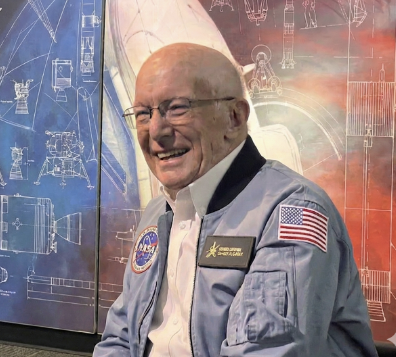
Apollo’s legendary Flight Director (Apollo 7, 12, 15, 17) and JSC Center Director,
Gerry Griffin during a visit to FDL HQ.
Summary of FDL Heliolab Contributions
-
Analysis Ready Data (ARD) (2023)
Case Study Phase
The Foundation: Unlocking NASA’s FleetCritical Function
Data Standardization: Transforms the massive SDO archive into clean, standardized, ML-ready datasets, providing the essential calibrated input data to power downstream models.Novel Contribution
Created SDOMLv2 (ML-ready dataset) and a Virtual-EVE model to replace missing instrument data, deployed on a scalable cloud platform. -
ARCADE (2025)
Case Study Phase
Mission Operations: Reading the Sun’s IntentCritical Function
Early Warning: Decodes solar magnetic flux of active regions to forecast instabilities and flag hazardous areas days before eruption.Novel Contribution
Integrates physics-based differential equations with deep learning (PINN) and uncertainty quantification. -
Decoding Solar Wind Structure (2025)
Case Study Phase
The Context: Knowing the Invisible River
The Foundation: Unlocking NASA’s FleetCritical Function
Environment Analysis: Identifies the background solar wind structure (e.g., Stream Interaction Regions) the CME will travel through, assessing potential impact severity.Novel Contribution
Combines iSAX compression and HDBSCAN clustering to identify solar wind structures and their source regions and integrated with SDO-FM to predict solar wind across the ecliptic plane. -
Forecasting Radiation Exposure (2024)
Case Study Phase
The Crisis: The Radiation StormCritical Function
Critical Function
Astronaut Protection: Predicts the onset and decay profile of radiation events, determining exactly when crews must shelter and when it is safe to exit.Novel Contribution
Developed a multi-modal sequence-to-sequence model with dropout to forecast future radiation dose rates and their decay profiles hours in advance. -
Ionosphere-Thermosphere Twin (2025)
Case Study Phase
The Footprint: Resilience on EarthCritical Function
Communications Stability: Forecasts ionospheric Total Electron Content (TEC) to correct GNSS signal delays, maintaining vital telemetry locks with spacecraft.Novel Contribution
Created SDOMLv2 (ML-ready dataset) and a Virtual-EVE model to replace missing instrument data, deployed on a scalable cloud platform. -
Multimodal Flare Prediction (2025)
Case Study Phase
Mission Operations: Reading the Sun’s Intent
The Foundation: Unlocking NASA’s FleeCritical Function
Precision Targeting: Acts as a "virtual" X-ray sensor to pinpoint the exact location of building flares, confirming their connectivity to the Earth-Moon system.Novel Contribution
Vision Transformers (ViTs) used to translate EUV images into Soft X-ray flux estimates while providing spatial localization attention maps of flare sources. -
Multiscale Geoeffectiveness (2023) & Geoeffectiveness Continual Learning (2024): SHEATH model
Case Study Phase
The Context: Knowing the Invisible River
Critical Function
Arrival Timing: Provides multi-day forecasts of solar wind parameters at L1, refining the arrival window for the CME and storm at the Earth-Moon system.
Novel Contribution
Uses solar imagery to forecast solar wind parameters at L1 with multi-day lead times, enabling adaptive forecast refinement when coupled with in-situ models. -
Orchestrator (2025)
Case Study Phase
Orchestrating AI Infrastructure for ScienceCritical Function
AI Infrastructure: Enables parallel orchestration of models via heliophysics reasoning framework, moving beyond single-use workflows to integrated decision-making.
Novel Contribution
Created a heliophysics specific reasoning framework to coordinate multi-agent workflows with human oversight, automating complex science tasks like data pipelines. -
SDO-FM / Surya
Case Study Phase
The Foundation: Unlocking NASA’s FleetCritical Function
Cross-Modality Insight: Massive foundation models that reveal hidden connections between remote solar imagery and in-situ plasma readings, powering the downstream models.Novel Contribution
Pretrained foundation models using massive solar datasets, enabling downstream tasks to leverage compact embeddings for classification and forecasting. -
Spectral Irradiance of the 3D Sun (SPI3S) on Mars (2024)
Case Study Phase
The Foundation: Unlocking NASA’s FleetCritical Function
System-wide View: Generates a 4D solar model to estimate irradiance impacting other solar system locations (e.g., Mars transit), ensuring total asset awareness.Novel Contribution
Creates a 4D (3D + temporal) representation of the Sun (SuNeRF) combined with MEGS-AI to estimate spectral irradiance from novel viewpoints anywhere in the solar system. -
Thermospheric Drag (2023) & Thermospheric Density Continuous Learning (2024): Karman-CL model
Case Study Phase
The Footprint: Resilience on Earth
Critical Function
Satellite Safety: Predicts thermospheric density changes to anticipate increased drag, enabling timely collision avoidance maneuvers for LEO satellites.Novel Contribution
Implements a continual learning framework for thermospheric density forecasting using Temporal Fusion Transformers, allowing the model to update with real-time data ingestion.